

When Your First Bully Called Herself “Mom”

Last week, in my piece, “We Need to Talk About Why Some Men Enjoy Humbling Black Women,” I said something that deserved its own room:
“For some brothers, the first person who mocked them, shamed them, emasculated them, dismissed their feelings, or made tenderness feel unsafe was their mother.”
And before we go further, if you have not read that deep dive yet, I encourage you to sit with it first because this conversation is an extension of that one.

Because the truth is, this conversation did not come out of nowhere.
It came from me watching some men celebrate the public humiliation of Black women like it was sport.
Watching mockery become community.
Watching cruelty become content.
Watching emotionally unavailable men build entire personalities around “humbling” women who already carry the emotional weight of this country on exhausted backs.
And in that piece, I kept asking myself:
Why do some men seem almost delighted by Black women being embarrassed publicly?
Why does confidence in Black women trigger rage in some people instead of admiration?
Why do some men interpret boundaries as disrespect?
Why does a Black woman loving herself feel like provocation?
And while writing all of that, another truth kept tapping me on the shoulder.
A quieter truth.
A heavier one.
Because if we are truly going to talk about wounded masculinity, emotional violence, misogynoir, domination, emotional shutdown, and why some men confuse cruelty with power…
…then eventually we have to tell the truth about where some of that pain began.
Home.
And fam…
That conversation is uncomfortable because Black people have survived by protecting family narratives.
We know how to preserve appearances.
How to say:
“She did the best she could.”
“He put food on the table.”
“Respect your elders.”
“What happens in this house stays in this house.”
And listen.
Sometimes all of that is true.
But survival language can also become silence language.
And some Black boys paid for that silence with their emotional health.
Now before some of y’all tighten your chest while reading this, hear me all the way through:
This is not an attack on Black mothers.
Black mothers have held this community together in ways history books will never fully honor.
They carried babies while carrying trauma.
Worked jobs while carrying grief.
Loved children while never being loved properly themselves.
Some Black mothers survived impossible conditions with no softness, no protection, no therapy, no village, and no room to collapse.
I know that.
But survival mode can still wound people.
Intent and impact are not always twins.
And some Black boys were not emotionally safe at home.
Some were loved through criticism.
Loved through fear.
Loved through yelling.
Loved through humiliation.
Loved through emotional inconsistency.
Loved through violence.
Some boys learned very early that tenderness was dangerous.
I know because I was one of them.
I was in kindergarten.
Let that sink in.
I had barely even learned how to write complete sentences yet.
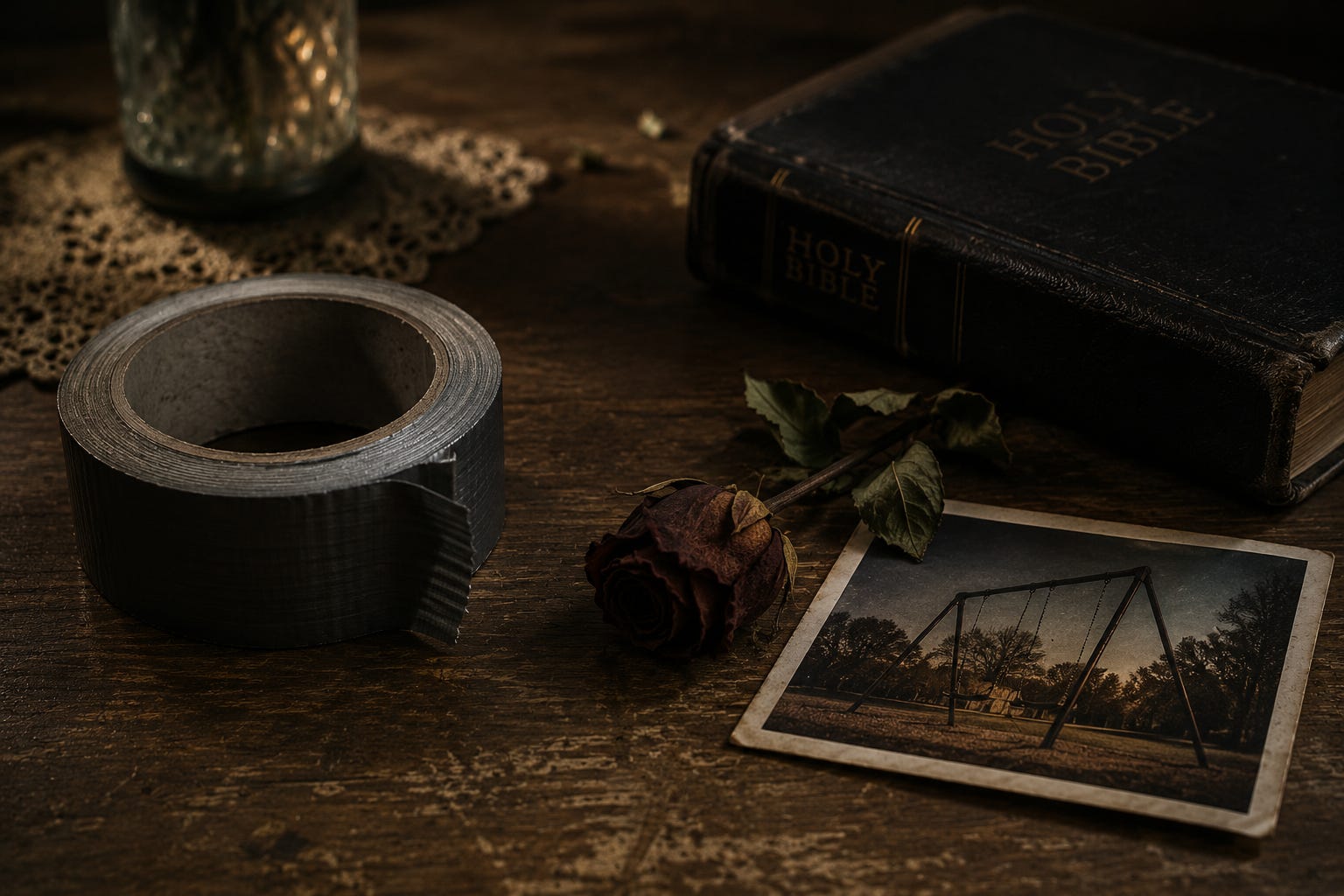
And my mother, the same person who gave me life, wrapped duct tape around my wrists and ankles and pressed a pillow over my face.
More than once.
Not once.
More than once.
And even writing that now feels surreal because some pain sounds unbelievable once spoken out loud.
But my body remembered.
Even when I tried not to.
Even when I minimized it.
Even when I buried it beneath achievement, humor, kindness, emotional intelligence, leadership, spirituality, performance, and survival.
My body remembered.
That was the first time I truly felt unsafe.
Not scared of monsters under the bed.
Unsafe in the arms of the person biologically designed to protect me.
And there is a particular kind of psychological confusion that happens when the first person who teaches you fear is also the first person who was supposed to teach you safety.
That changes something in a child.
That rearranges trust.
Because if your own mother can become danger…
Then what does protection even mean after that?
What does softness mean?
What does love mean?
And somewhere deep inside me, whether I said it out loud or not, a question began living in my spirit:
If my own mother could hurt me like this… who will ever love me safely?
Now hear me carefully.
I did not become a man who hated women because of my pain.
I did not become obsessed with humiliating Black women to reclaim power.
I did not become emotionally cruel.
I did not become addicted to dominance.
I did not build a platform around tearing women down because tenderness once felt unsafe to me.
In many ways, I became the opposite.
Hyperaware of people’s feelings.
Protective.
Empathetic.
Emotionally intelligent sometimes to the point of exhaustion.
Because trauma does not always make people hard.
Sometimes it makes them deeply committed to never becoming what hurt them.
And that is important for me to say because this piece is not about excusing misogyny.
Not at all.
Trauma may explain behavior.
It does not excuse cruelty.
But I can still have compassion for brothers who grew up emotionally bruised by women they loved and feared at the same time.
Because some Black boys learned survival before they learned softness.
Some were mocked for crying.
Some were shamed for vulnerability.
Some learned that emotions got punished.
Some were parentified and forced to emotionally carry adults before they even understood themselves.
And when little boys learn that tenderness is unsafe, many grow into men who struggle to trust intimacy.
Not because they are incapable of love.
But because vulnerability reminds them of danger.
And if those wounds go unhealed?
Pain starts shape-shifting.
Sometimes into emotional distance.
Sometimes into hypermasculinity.
Sometimes into manipulation.
Sometimes into detachment.
Sometimes into domination.
Sometimes into bullying women before women can emotionally reach them first.
And that is the part some folks do not want to discuss.
Because some men are not responding to women in the present.
They are responding to unresolved pain from the past.
Some men do not hear accountability.
They hear shame.
Some do not experience emotionally intelligent women as safe.
They experience them as threatening.
Some hear boundaries and immediately feel controlled.
Some hear emotional honesty and immediately feel exposed.
So instead of self reflection, they choose domination.
Instead of healing, they choose ego.
Instead of vulnerability, they choose performance.
And social media made this dysfunction profitable.
Now wounded men can monetize emotional immaturity.
Entire platforms built on:
“Women need to be humbled.”
“Women are the problem.”
“Submission.”
“Modern women.”
“Masculinity.”
Meanwhile many of these men are spiritually bleeding all over microphones.
And because patriarchy rewards emotional suppression in men, some people mistake emotional unavailability for strength.
But fam…
A man disconnected from his feelings is not automatically powerful.
Sometimes he is just emotionally stranded.
And if we are honest, some men feel more comfortable controlling women than understanding themselves.
That is the truth sitting underneath a lot of this.
And before somebody twists this piece into “mother blaming,” let me say this clearly:
You are allowed to acknowledge your wounds without demonizing your mother.
Both can coexist.
You can understand her suffering and still tell the truth about your own.
You can have empathy for what she survived while still grieving what you lost.
Because some Black mothers were trying to raise children while emotionally drowning themselves.
Some never received softness either.
Some never learned emotional regulation.
Some normalized survival mode.
Some confused toughness with preparation.
And unfortunately, some boys inherited emotional violence disguised as strength.
That is not condemnation.
That is generational grief.
And if we never tell the truth about emotional inheritance in Black families, we will continue recycling pain while calling it culture.
Now let me say something else that matters deeply to me:
Black women are not responsible for healing wounds they did not create.
Too many Black women have spent generations carrying men emotionally while simultaneously surviving emotional harm from men.
That contradiction is exhausting.
And honestly, some Black women are tired.
Tired of being asked to understand everybody while nobody understands them.
Tired of being called “strong” while silently drowning.
Tired of translating emotional immaturity into potential.
Tired of becoming therapists inside relationships instead of partners.
And truthfully?
I do not blame them.
Because Black women deserve emotional safety too.
They deserve tenderness too.
Gentleness too.
Consistency too.
Protection too.
Not performative protection rooted in ownership.
Real protection.
The kind rooted in emotional responsibility.
And I think what disturbs me most is watching some men publicly ridicule Black women while secretly carrying unresolved pain from women who hurt them long ago.
Because unhealed pain has a way of searching for targets.
And if a man never confronts the little boy still grieving inside him, eventually everybody around him pays for wounds they did not create.
That is why healing matters.
Real healing.
Not internet masculinity.
Not podcast philosophy.
Not “high value man” branding.
Real healing.
The kind that forces you to ask:
Why does vulnerability scare me?
Why do I feel powerful when women feel small?
Why does emotional accountability feel like disrespect?
Why do I confuse emotional control with masculinity?
Because some Black men never actually learned peace.
We learned performance.
And there comes a point where every grown man has to decide:
Will I become a student of my pain?
Or a distributor of it?
That question matters.
Because I still believe Black men can heal.
I still believe tenderness belongs to us too.
I still believe accountability is masculine.
I still believe emotional honesty is masculine.
I still believe softness and strength can exist in the same body.
And I especially believe this:
Breaking cycles requires more courage than continuing them.
Some of us have to become the gentleness we never received.
Some of us have to teach ourselves that love does not have to arrive carrying fear in its hands.
Some of us have to mother ourselves back to life.
And maybe that is the real work.
Not pretending the wound never happened.
But refusing to let the wound make us cruel.
“I still believe softness and strength can exist in the same body.” 💯for sure, I think strength is acknowledging what makes us weak yet refusing to remain powerless. Masculinity became toxic when it became one dimensional, femininity is so easily embraced because of how many different angles it can encompass. Somewhere along the way, we internalized that masculinity can only look like one thing and it left us ill prepared to handle the challenges that life throws at us. Masculinity means protecting the most vulnerable among us, not making them feel even more exposed🤦🏽♂️
Powerful. Thank you for speaking truth!